

DUDLEY
1835
This place is justly celebrated for flint glass which is here manufactured to a great extent in the most elegant manner for foreign as well as home trade, the nail branch also employs an immense population in this and the neighbouring parishes and fire irons, vices, anvils, traces with many other descriptions of hardware are produced in great quantities. In the vicinity of the town are almost inexhaustible mines of coal and iron stone and quarries of lime stone …
A stranger who approaches the town of Dudley in the evening will be much surprised at the innumerable lights seen in every direction issuing from furnaces, forges, collieries &c imparting not only to the face of the earth but also to that of the firmament an appearance of one universal illumination.
Pigot and Co.’s National Commercial Directory
1851
Six million visitors flocked to Crystal Palace to marvel at the wonders of British manufacturing and the riches of the British Empire when The Great Exhibition opened its doors from 1 May to 11 October 1851. Cochrane and Co, Woodside Iron Works, in Dudley had supplied most of the ironwork required for the Great Exhibition building.
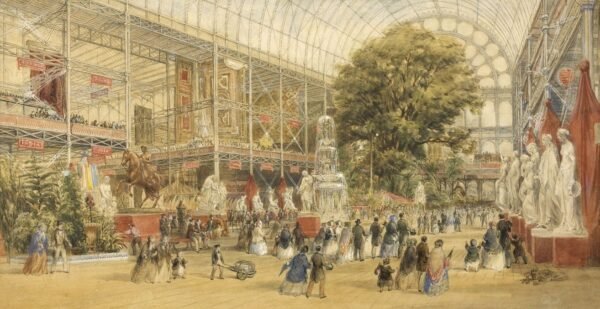
Displays from Dudley included a fountain manufactured by the same Cochrane and Co, castings for furniture, fenders and fire-guards as well as a huge block of coal mined at Dudley Port.
During these same months, on 6 August 1851, a superintending government inspector of health, William Lee, opened a Public Enquiry in Dudley and went on to interview the town’s officials and inhabitants as well as extensively inspect the town. His report on ‘sewerage, drainage and supply of water, and the sanitary conditions of the inhabitants of the parish of Dudley’ based on his enquiry was published in the following year in 1852. Dudley may have been at the heart of Britain’s industrial revolution but those labouring in the local industries evidently experienced little of the wealth and prosperity created by the boom in Britain’s manufacturing showcased at the Great Exhibition.
In fact, many of Dudley’s inhabitants existed in an abyss of poverty and deprivation. Industrialisation had brought about a rapid growth in population rising from a figure of 10,107 in 1801 to 37,954 in 1851. Fields around the town had quickly developed into a dense huddle of streets and courts with housing, workshops, pubs and shops packed together with little or no planning in scenes of unmitigated filth and stench. Hundreds had died in the town during an outbreak of cholera in 1832, many children had died of malignant scarlet fever a year later and epidemic typhus or ‘Irish fever’ had struck in 1847. Two years later in 1849, Asiatic cholera, spread by contaminated food and water, hit Dudley causing the deaths of somewhere between 500 and 600 people.
At the time, Charles Clark, a chemist and druggist with premises in Dudley’s market place, documented that:
The general trade of the town and district was now in a most deplorable state, and in the recollection of the old tradesmen it was never known to have been so bad. Added to the distress, the puddlers and colliers, &c., received notice for a reduction in wages of 10 per cent., which was equal to 6d. per day. At this distressing period of our history, men, women, and children, in a state of absolute starvation, were seen daily dragging a light wagon through our streets, asking for alms of loaves of bread and victuals for their famishing families, shewing the dire disasters that had visited our old town and locality. To make matters worse, seventeen shops, ranging from St. Edmund’s to St. Thomas’s Churches, were “to let” at this unhappy time.
Absence of drainage and pavements, disgusting stinking privies and soil pits, overcrowding, deficient quality of food, lack of ventilation, butchers killing on their premises and ubiquitous pigsties all contributed to an overall picture of squalor and wretchedness. Water was in extremely short supply and all kinds of waste and filth stagnated or simply flowed along surfaces.
William Lee reported:
The district is now disfigured by offensive accumulations of liquid and solid filth, by chasms which have resulted from mining operations, by houses and other buildings everywhere cracked, broken, sinking and out of perpendicular so as to be fearful to look at and dangerous to live in, by mountainous accumulations of mine refuse, and slag and cinders from the ironworks, and by a canopy of dense smoke covering incessantly many miles of surface.
It is little wonder that disease stalked the streets. To quote Lee again:
The gloom which overhangs Dudley and the surrounding district, from the smoke of its mines and works, is dismal to the eye; but a gloom of a more fearful character, to the eye of the mind, rests upon the district when the average age at which inhabitants die is considered. In no other part of England or Wales is the work of human extermination effected in so short a time as in the district surrounding Dudley and in no other part, even of that district, is the time so short as in the parish of Dudley. So far as the duration of life, therefore, is concerned, Dudley is the most unhealthy place in the country.
In a table, Lee went on to give an average age of death of 29 years 4 months for the whole of England and Wales citing an average of 29 years for London, 23 years 9 months for Birmingham, 23 years 4 months for Leeds, 22 years 11 months for Manchester, 20 years 5 months for Liverpool and 19 years 1 month for Wolverhampton. From today’s perspective, these numbers are shocking enough but Dudley languished far at the bottom of the table with an average age of death of 16 years 7 months. In a ranking for life expectancy in 2026, Nigeria was ranked as the lowest country in the world with a life expectancy of 54 years, over three times as long as that in Dudley in 1851.
The proportion of those dying under the age of one made up one third of all the deaths in Dudley on average. Those under the age of five made up 59.1% and those under 15 67%.
Lee concluded:
I am acquainted with no parallel to the case of Dudley, where … seven tenths of the deaths for the last ten years have been of persons under the age of 20 years. … in Dudley only about three of every ten human beings born into the world survives to years of maturity.
Streets of Deprivation
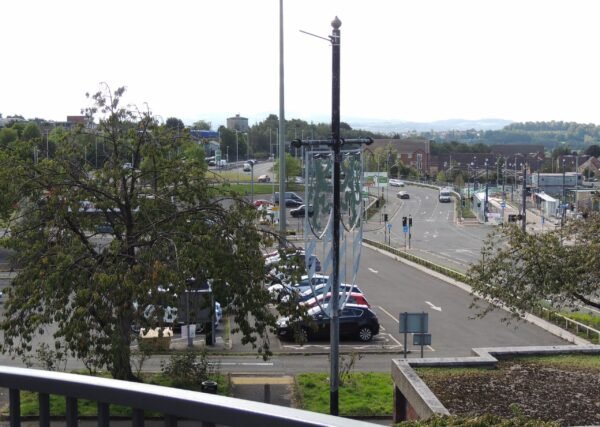
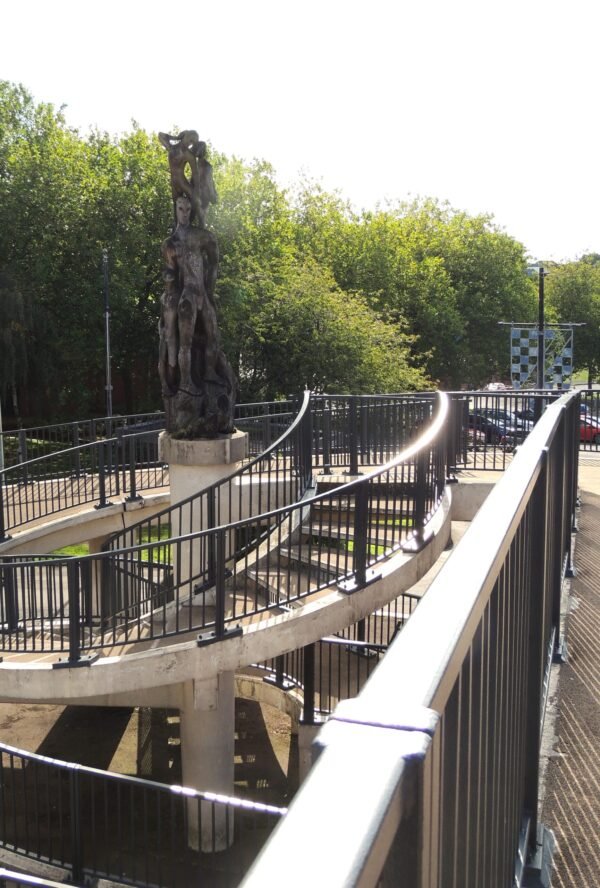
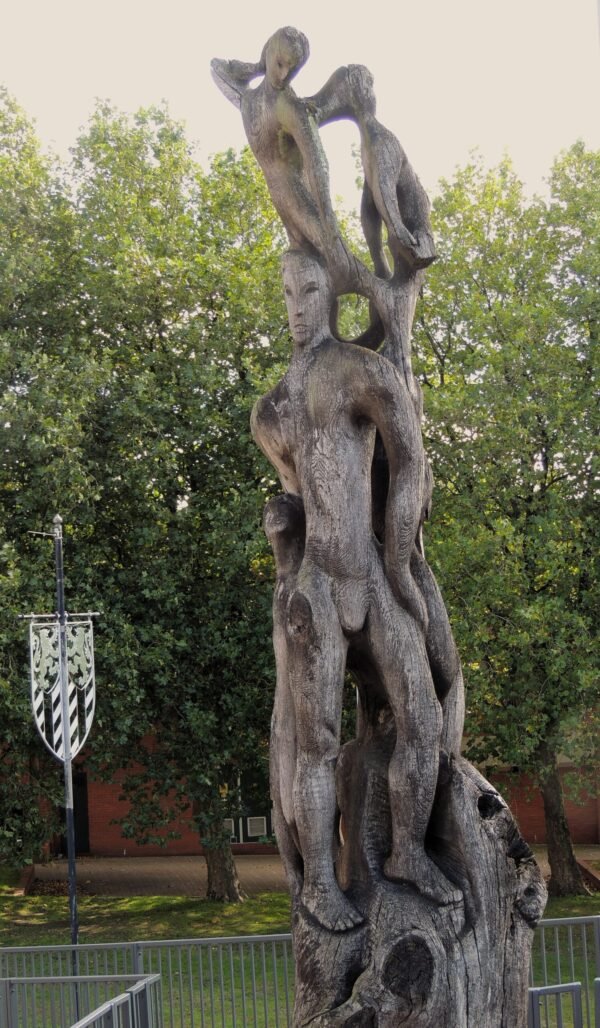
Today in Dudley, a footbridge from Flood Street car park crosses King Street across to the Churchill Shopping Precinct. A carving was placed at this footbridge in 1963 which many people pass today without registering its significance. It is of a man, woman and three children and represents the hardship and struggles of families living in the mass of streets, alleys and courts that once occupied the area looking back from this footbridge.
Mamble Square, or the area known as ‘Mambles’, lay on the area of the car park between Flood Street and Oakeywell Street. Harry Smitheman, a police constable interviewed by Lee, remarked,
If I were asked where the greatest prostitution for money took place, I should say Brandy Row and the Mambles. There are many public houses where prostitutes resort to and drink with men; they adjourn from these places to their dens, as we call them, in Brandy Row and the Mambles.
Lee visited Mambles for himself,
Fifty to sixty houses, no water. Mr Richardson says if the company were to lay a pipe for two or three houses, all the others would use it without paying. All dirty, pallid, disease and some idiots. The people complain, even in the midst of their filth, of want of water. All so bad as to be indescribable; a man almost dying; a woman with half a face; children almost devoured with filth; prostitutes and thieves. The physical and moral condition of this place is indescribable.
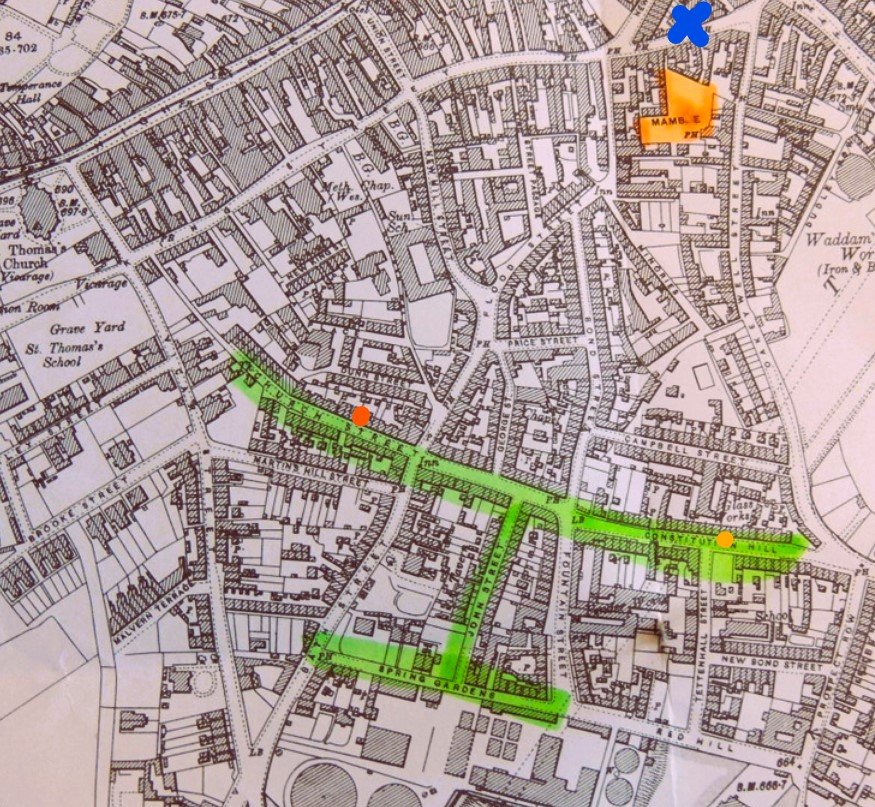
Flood Street formerly led into Bath Street and Constitution Hill and Church Street crossed at the junction. Both Church Street and Constitution Hill exist today but Church Street was formerly a longer street coming downhill from St Thomas’ Church while Constitution Hill followed downhill from the junction with Flood Street at a different angle to the present day Constitution Hill. These are the streets where my great great great grandparents, William Jeavons and Mary Jewkes, lived.
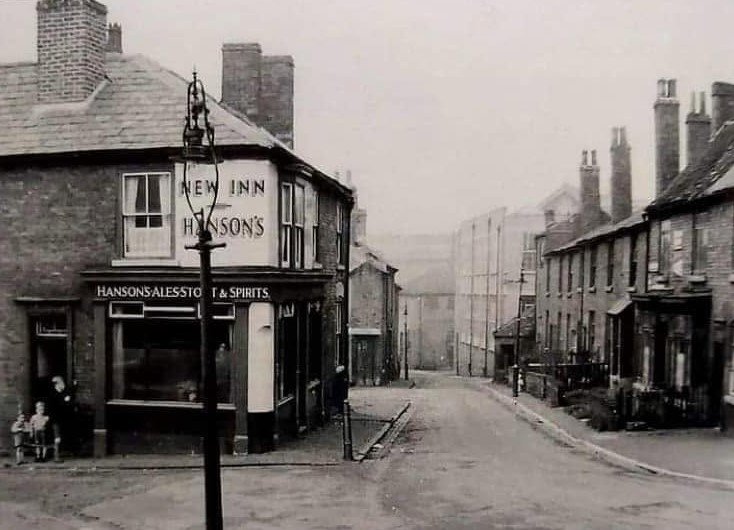
William Jeavons & Mary Jewkes
William Jeavons was born in Dudley in 1812 and baptised on 3 January 1813 at St Thomas’ Church, the sixth child of Andrew Jeavons, a nailer of Dudley, and Hannah Nail. He married Mary Jewkes (or Jukes), a nailer, in 1835 and by the time of the 1851 census and William Lee’s inspection was 38 years old and living on Constitution Hill with his wife and 8 children. He was a coal miner and his eldest sons, Daniel (14) and Joseph (12), were fire iron makers. His other children were William (10), Phebe (8), James (6), Mary Ann (4) (my great great grandmother), Ruth (2) and John (2 months).

A total of 420 people including children were living in 79 dwellings on Constitution Hill in 1851. A closer examination of the occupations of these residents is testament to the range of industry in Dudley at the time:
- 25 coal miners
- 14 stone miners (probably ironstone or limestone)
- 10 labourers
- 10 brass founders
- 10 cordwainers (shoemakers)
- 7 tailors (1 master tailor)
- 7 tailoresses
- 6 nailers (5 women)
- 5 servants (4 women)
- 5 moulders
- 5 vice makers
- 4 dressmakers (women)
- 4 anvil makers
- 3 gas fitters
- 3 glass cutters
- 2 chain makers
- 2 glass blowers
- 2 bookbinders
- 2 victuallers (publicans)
- 2 apprentices to tailoring
- 2 brass tap makers
- 2 porters
- 2 fire iron makers
- 1 gardener
- 1 whitesmith (polisher or finisher of metal goods)
- 1 boiler maker
- 1 hatter
- 1 engine man
- 1 crate maker
- 1 colliery clerk
- 1 clerk to an iron merchant
- 1 fire iron filer
- 1 lamp lighter
- 1 malster (beer brewing)
- 1 iron moulder
- 1 glass maker
- 1 gas man
- 1 carriers clerk
- 1 brass worker
- 1 brass fitter
- 1 boot shoe maker
- 1 retail brewer (woman)
- 1 charwoman
- 1 washerwoman
- 1 milliner and straw bonnet maker (woman)
- 1 seamstress
- 1 bagmaker (woman)
- 1 retired nail factor
- 1 retired mariner
According to the census, no children below the age of 10 were working but the census did record a number of children working between the ages of 11 and 15 including William Jeavons’ sons working as fire iron makers. Brothers Charles (13) and John Smith (11), Thomas Fryer (11), James Williams (12) and Thomas Harper (13) were brass founders, Thomas Hobbs a 14 year old coal miner and his brother William a 12 year old stone miner. Isaac Wheldon (15) was registered as a labourer, Henry Jackson (13) as another stone miner, Thomas Parkes (13) as a gas fitter, John Skidmore (13) as a glass blower, Eliza Shepherd (13) as a tailoress and Anne Ray (14) as a bag maker, presumably for the nail industry.
The land on Constitution Hill had belonged to the Earl of Dudley and sold to the Oxford, Worcester and Wolverhampton Railway Company, ‘whose tunnel goes this way, and a shaft sunk amidst the houses.’ William Lee criticised the Earl of Dudley for selling land without making arrangements as to the character and levels of buildings, drainage, sewerage or pavements, all of which Lee claimed were major causes of the terrible conditions in the town. Constitution Hill had no drainage or pavement and the houses were built with ‘accidental levels’ but supplied with water.
The dwelling occupied by Charles Cooper, an anvil maker and near neighbour of William Jeavons was described in William Lee’s report:
An abominable privy, quite full, adjoins a house occupied by Charles Cooper, whose wife is now ill from the stench, she had all the symptoms of low fever, and said, ‘I began to be poorly on Saturday, when the smell came in very bad. I have a pain in the head and stomach: no appetite. I tremble, and cannot hold a limb still. I break out into sweats and feel low and faint. My bowels are affected.’ There is another privy behind.
Another neighbour Mary Ann Histon, a 42 year old widow and retail brewer, also lived nearby with six children:
The yard is small, and there are three pigsties and a privy. Stench bad, In Mrs. Histon’s upper house the drainage from the houses above comes under the next house, and percolates through the wall of the front room.
The quality of the retail brewing can only be imagined.
1861
In spite of the low life expectancy averages, Dudley’s population had risen by a further 6,000 by 1861 which presumably did little to improve the cramped living conditions in parts of the town.

William Jeavons and his family had moved to the adjoining Church Street. 13 people were living in the household:
- William and his wife Mary
- sons Daniel (23) and William (20) – fire iron makers
- daughter Mary Ann (14), daughter Ruth (12), son John (10), daughter Eliza (6), son Andrew (3)
- daughter Phebe, a bagging weaver – probably manufacturing bagging for the packing of nails, her husband William Parkes (19), a coal miner, and their six month son, William.
- a lodger, John Burch, a coal miner.
William’s son, James, had died at the age of 11 in 1856. His son, Joseph, had married Isabella Newey and was living on Prince Albert Street and working as a grinder and glazier.
William Jeavons died on Church Street on 3 August 1862 at the age of 49, seemingly an advanced age when taken against the averages in Dudley. The cause of his death was registered as ‘dropsy’, a swelling of the body or part of it due to the build up of fluid, maybe caused or at least exacerbated by the appalling conditions in which he had both lived and worked.
Mary (Jewkes) Jeavons
On his death, his widow Mary was left to care for 2 children under the age of ten, Andrew and Eliza, as well as a six month infant, Emma. Life certainly did not become any easier. The Birmingham Daily Post in 1866 confirmed that little had changed in Dudley since the publication of Lee’s report and that many parts of the town were in a ‘fearful condition’:
For a large portion of the town of Dudley consists of ill constructed courts and lanes and alleys, in which the houses are built back to back so that there can be no thorough draught of air – in which foul privies and open soil pits lie under bedroom windows – in which there is often nothing but a dilapidated channel or footpath of rough stones and bricks and oftener no paving at all – in which surface drainage, garbage and refuse lie decomposed in malarious puddles, and in which cholera, fever and small-pox find most of their victims.
There was one significant change in that pigs had been banished from the town improving the situation slightly but the newspaper report decried the location and practices of slaughter houses in the town, the odours from tallow works and mining operations that meant the ground was ‘in constant motion’.
Lee had described property in Church Street as being very confined with bad drainage, privies without ash pits and unpaved yards as well as the street having no under drainage. The Birmingham Daily Post described the crowded back premises lying between Dunn, Flood and Church Street estimating that about five per cent of the land could be designated as open areas which were nevertheless “crammed with privies, refused heaps and surface drains.”
The report went on:
Here it may be mentioned that the poor of Dudley bake their own bread and that they bake it in ovens outside their houses … there are many instances where the oven in which the bread of several families is baked runs right out either to the wall of a privy, or to the wall of some ash pit, into which the privy soil is allowed to flow.
By 1871, at the age of 58, Mary was still living in the same huddle of streets in the inappropriately named Spring Gardens, a name that may have come from the time the area was open fields but the site of Dudley’s gas works in the latter part of the nineteenth century.
A charwoman by this time, Mary was living with her four youngest children: John (19) an apprentice fender maker, Eliza (15) a nail bagging weaver, Andrew (13) an errand boy, Emma (9), and a boarder who worked as a coal pit labourer. Mary’s daughter Ruth and her husband William Smith, a furnace man, and their first child, William, lived a few dwellings away on the same street together with Ruth’s sister Mary Ann and her illegitimate child, Joseph.
Two of Mary’s children, Andrew, by then a whitesmith polisher, and Emma, a fire irons labourer, still lived with her in 1881 when Mary had moved again in same cluster of streets to John Street. Andrew had married Hannah Richards in 1879 and she and their first child, Eliza, were living in the same household. Mary died two years later when she was around 67 or 68 years old.