

Martha Holland & Timothy Edge
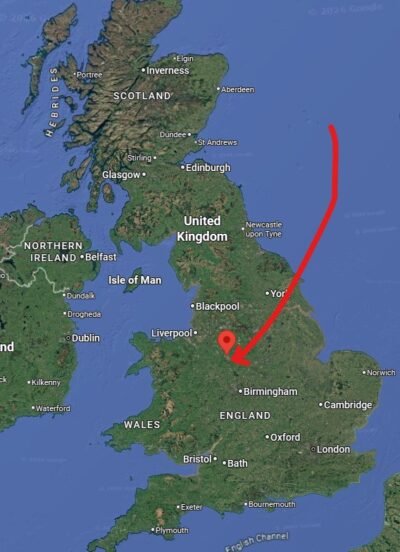
The ready availability of supplies of clay and coal gave rise to the pottery industry that established itself in in the towns and villages that now make up Stoke-on-Trent. The industry truly began to blossom in the 17th century with the town of Burslem becoming a renowned centre of pottery by the early 18th century. Josiah Wedgwood set up his first factory in Burslem in 1759. ‘The Potteries’ emerged as the centre of British ceramics. Pigot’s Directory for The Potteries in 1822 lists over 120 manufacturers of earthenware alone.
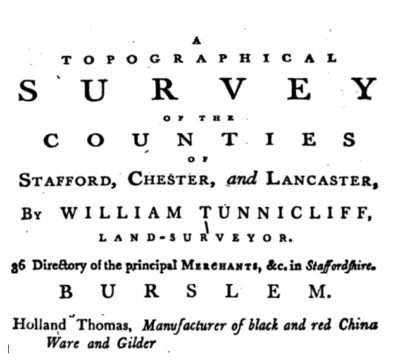
Thomas Holland established his pottery business at the Hill Top works to the north west of Burslem town centre in the 18th century.
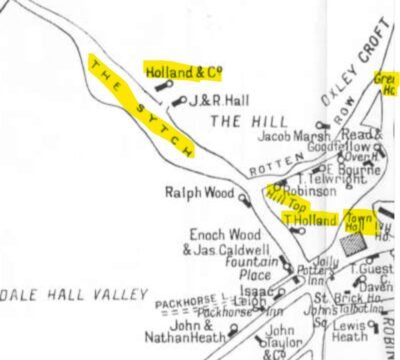
The very extensive Manufactory of Enoch Wood and Sons, (which covers the sites of five old factories) … presents all the appearance of a most extensive Laboratory, and the Machinery of an Experimentalist.
History of the North Staffordshire Potteries, Simeon Shaw (1829)
His second marriage was to Tomasen Allen, a painter of flowers on pottery, and their daughter, Martha Holland, was born in 1777. At the age of 22, she gave birth to her illegitimate son, James, born in Burslem in 1799.
A little less than a year later, she married a 24-year-old widower, Timothy Edge, in the Parish of Clent in the County of Worcestershire just to the south of the pottery my 6x grandfather, Ralph Edge, ran on Brettell Lane in the Black Country. Timothy was his youngest son. Ralph Edge hailed from the potteries and some kind of personal or business connection must have been made between Martha Holland in the Potteries and Timothy Edge in the Black Country.
Martha and Timothy resided in Burslem after their marriage. They shared a farm called Barnfield with Martha’s father and Timothy worked at the Holland pottery works.
When Thomas Holland died of consumption (tuberculosis) in 1807, Timothy inherited one half of the pot works at Hill Top. The other half was inherited by Martha’s brother, Thomas, who also inherited his father’s share of the farm. When Thomas died in 1839, his wife, Ann, took over the pot works, and Martha acquired the farm.
Timothy was described as a sagger in the Staffordshire Advertiser in 1810 and 1811, when he sold a sagger manufactory at Hole House in Burslem. A saggar is a protective fireclay box that encloses ceramic ware during firing. Pigot’s directory in 1822 listed Timothy under earthenware manufacturers as a maker of chimney pipes and flowerpots at Marsh Street in Shelton and Holehouse in Burslem. In June 1827, he was declared bankrupt, a bankruptcy that was principally due to a failed investment in a brewing business. At the time, the press stated Timothy was a colour maker.
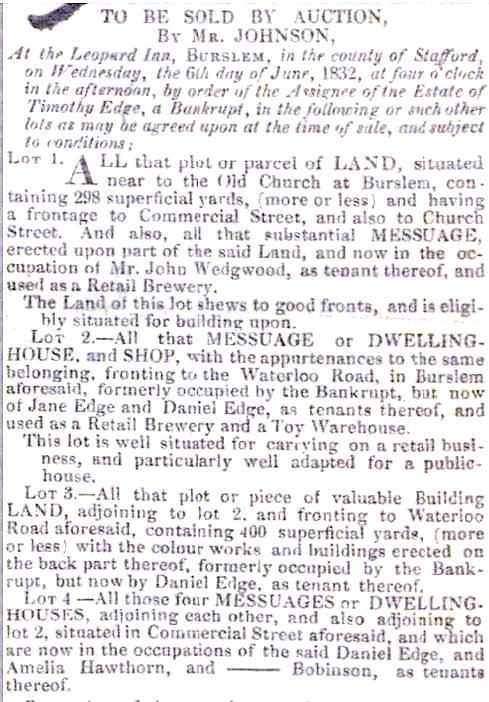
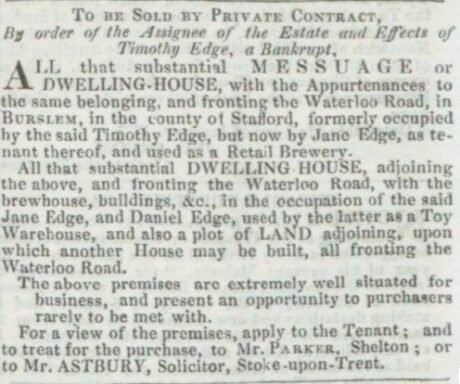
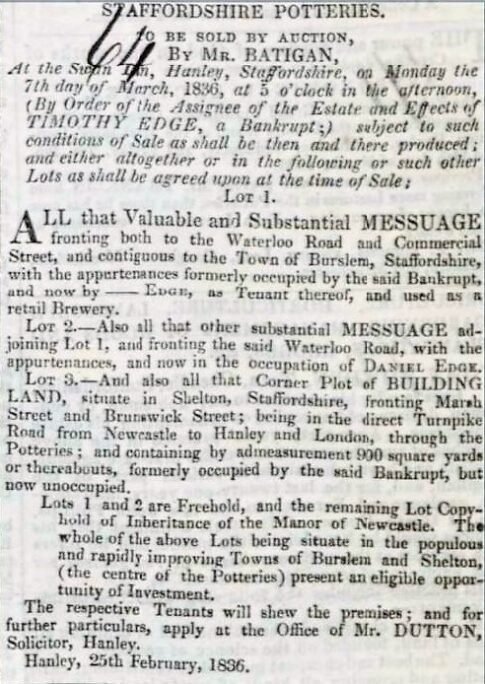
Timothy died on 4 August 1838 leaving his wife Martha to live on independent means. When she died in 1847, the death notice stated that Timothy Edge had been a china toy manufacturer, probably of china figures and ornaments.

The vast volumes of smoke and vapours from the ovens, entering the atmosphere, produced that dense white cloud, which from about eight o’clock till twelve on the Saturday morning, (the time of firing-up, as it is called,) so completely enveloped the whole of the interior of the town, as to cause persons often to run against each other; travellers to mistake the road and strangers have mentioned it as extremely disagreeable, and not unlike the smoke of Etna and Vesuvius.
History of the North Staffordshire Potteries, Simeon Shaw (1829)
The couple had 7 children:
Daniel (1803-1871) a china toy manufacturer m. Caroline Austin & Ellen Dewsbury
Timothy (1805-1883) a toy manufacturer and beer seller. Timothy had 3 children with Sophia Askey. The couple never married.
Daniel and Timothy went into partnership as makers of fine china figures.
Sarah (1807-1893) m. George Mollart, a potter’s modeller
Jane (1809-1880) m. George Gallimore, an engraver
Thomas Holland (1812-1884) a painter and artist m. Anne Harrell Puttock
Anne (1814-1899) m. William Clews & James Henry Hurrell, a tailor and draper
Thomasine Holland (1816-1897) m. Henry Steele, an engraver and artist.
James Holland – painter
Some sources state that Timothy Edge was James Holland’s father. Timothy and Martha baptised three of their children on 25 December 1805, but James Holland was named as the illegitimate son of Martha and not as Timothy’s son.
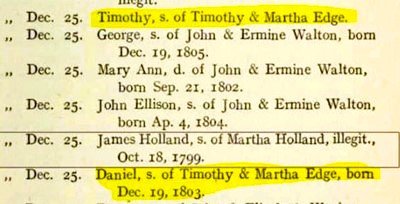
James never took the ‘Edge’ name, and it seems unlikely that Timothy was James’ biological father. Nevertheless, James grew up in the Edge household with Timothy as his stepfather and he returned on occasion to visit his family in Burslem once he had moved to London.
At Longport is a very extensive and convenient manufactory of Pottery, Porcelain, and Glass, belonging to John Davenport, Esq., & Sons; also another near Newport, his Business Residence. J. Davenport, Esq., is well known as one of the most enterprizing and successful Manufacturers. Of his worth as a private person, the numerous instances of his benevolence are the best testimonials.
History of the North Staffordshire Potteries, Simeon Shaw (1829)
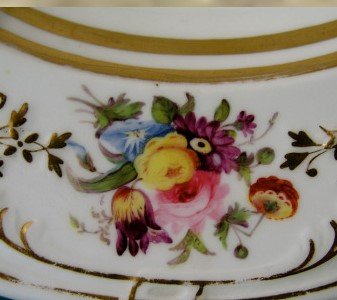
At the age of 12, James was apprenticed to the John Davenport pottery in Longton, just to the west of Burslem, to learn the skill of painting on china. On completing his 7-year apprenticeship, he left The Potteries for Deptford, a centre of pottery making, to work as a pottery painter.
He moved to London shortly afterwards with the aim of establishing himself as an artist. He lived in Southwark (1820), Marylebone (1823) and Warren Street off Tottenham Court Road (1824). The next year, he moved to Maple Street, then Queen’s Row, Camberwell in 1828, in 1829 to Rathbone Place, Marylebone and finally settled at Union Place in Greenwich where he lived until 1845.
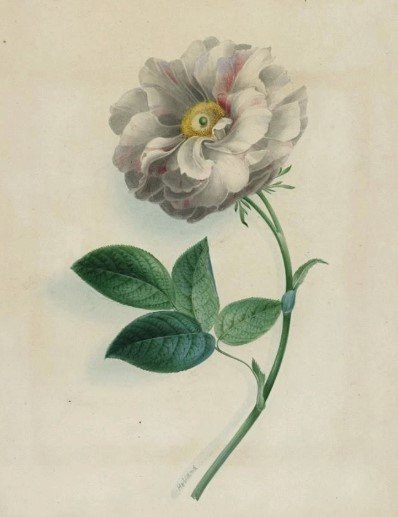
In April 1824, his painting, A Group of Flowers, was accepted for an exhibition at the Royal Academy. James then went on to be a prolific and successful artist who regularly exhibited at the Royal Academy (32 pictures), the Society of British Artists (108 pictures), the British Institution (108 pictures) and the Society of Painters in Water Colours.
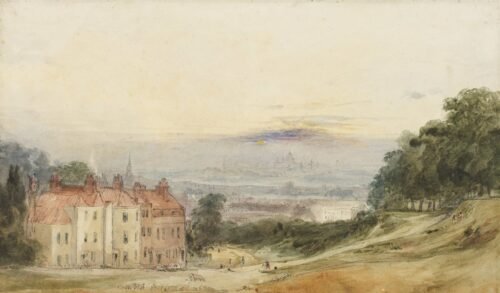
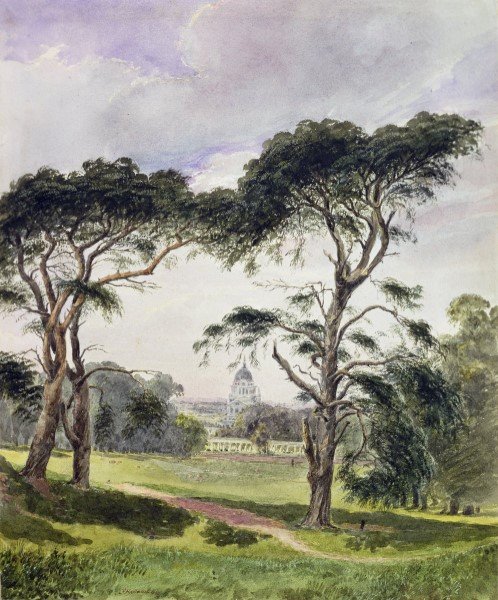
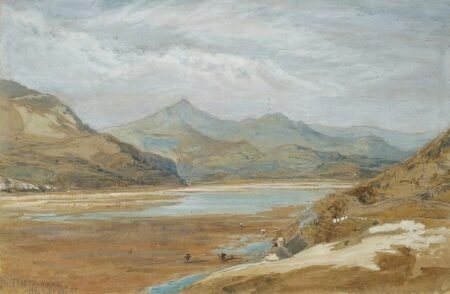
He travelled widely around Great Britain …
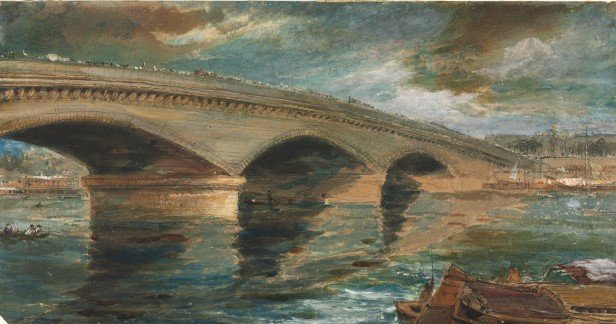
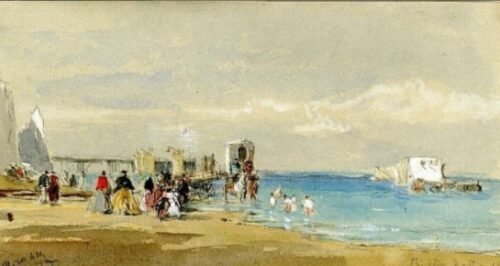
… and began the first of his continental journeys by visiting France in 1830. The Royal Academy exhibited his painting, Cathedral of St Denis, in 1832.
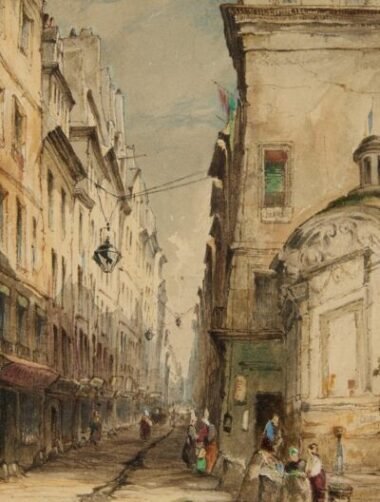
In 1835, he journeyed to Paris, Geneva, Verona and finally Venice, a location he painted many times.
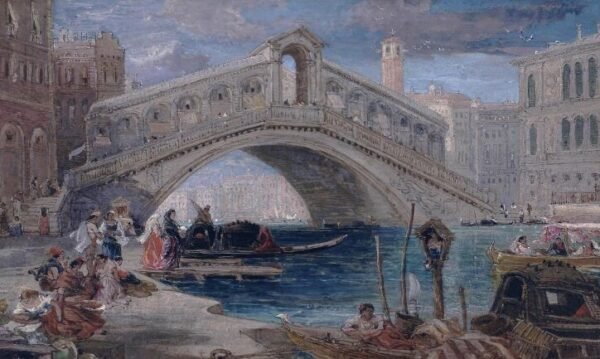
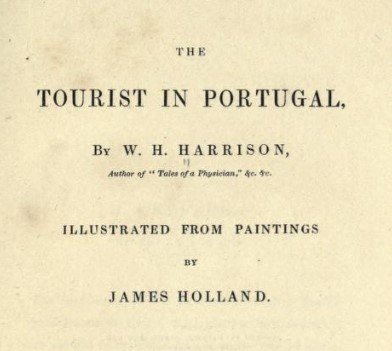
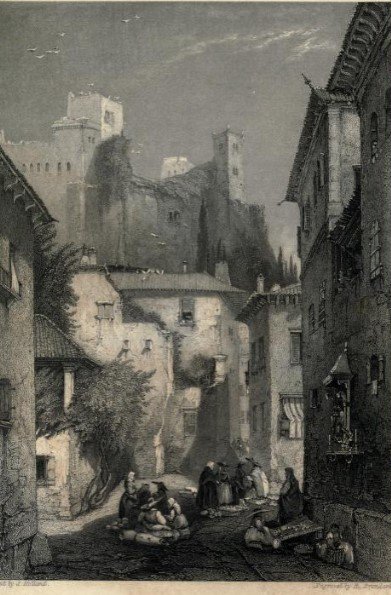
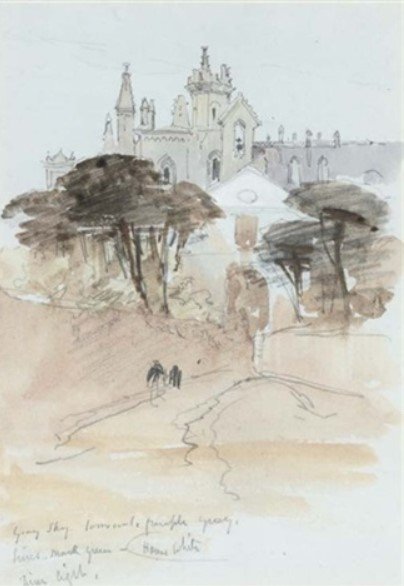
‘The Landscape Annual’, selected Portugal as its location in 1837 and commissioned James Holland to provide the illustrations.
Demand for James’ work increased:
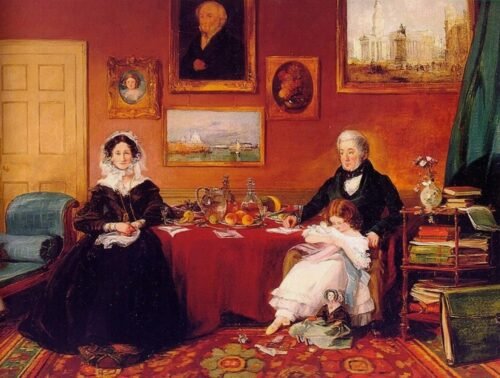
In the 1840s, he painted in Antwerp, Paris, Geneva, Rotterdam, Delft, Verona, Venice and Portugal. Steve Bond, (James Holland: The Forgotten Artist, 1999), records that James was selling many paintings and had a number of fee-paying pupils by that time. In 1845, he left Greenwich and moved to Osnaburgh Street near Regents Park.
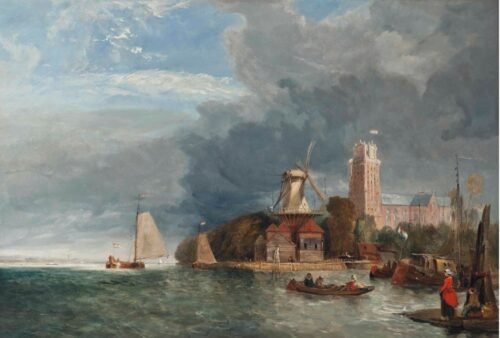
In the 1850s, James continued to travel in his home country as well as to Rouen, Normandy, Paris, Geneva, Rome, Corfu, Egypt, Verona, Venice, Genoa, Lucerne, Frankfurt, Munich, Innsbruck, Rotterdam, Portugal and Spain.
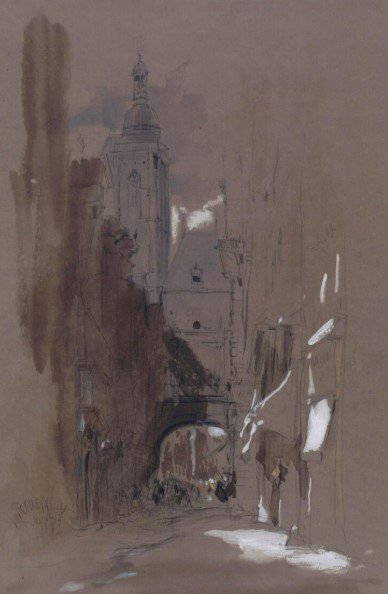
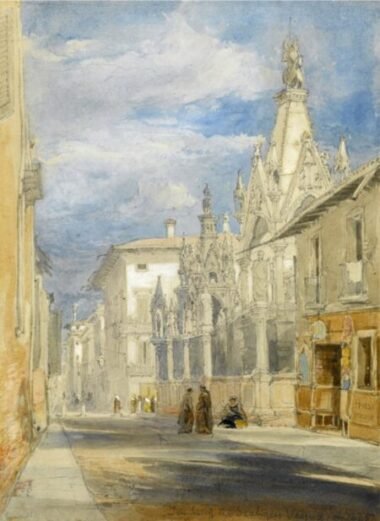
Following the death of his daughter, Emma Lavinia, in 1860 and the engagement of his daughter, Charlotte Morrant to Arthur Hird in late 1861 or early 1862, James painted in Greenwich and in Venice for the last time in 1864.
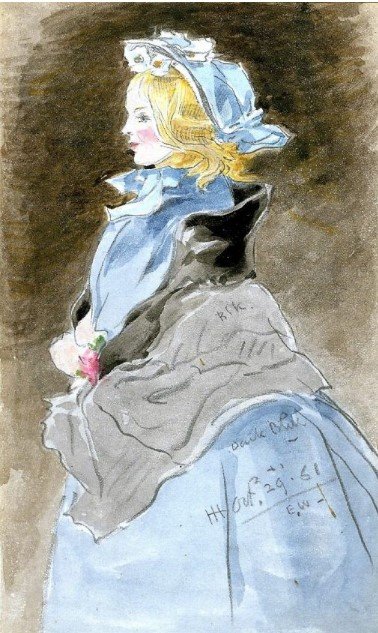
He then settled at Osnaburgh Street. In his last years, he organised and selected works for exhibitions at the Watercolour Society and exhibited his own work there for the last time in 1870. He last exhibited at the British Institution in 1867 and the Watercolour Society in 1870.
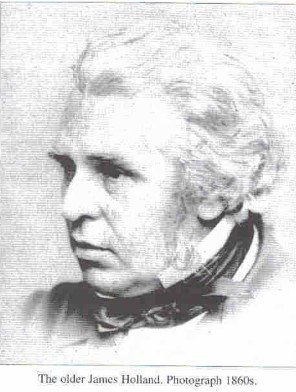
James died at his London home in Osnaburgh Street on 13 February 1870. He failed to wake up in the morning and his death was certified as due to ‘cirrhosis of the liver and exhaustion’. His grave is at Highgate Cemetery.
Today, James Holland’s works can be found at a number of museums and art galleries. These include the Potteries Museum & Art Gallery in Stoke-on-Trent, British Museum, Victoria & Albert Museum, Museum of London, Tate Britain in London, Birmingham Museum and Art Gallery, Manchester Art Gallery, Walker Art Gallery in Liverpool, Leeds Art Gallery, National Galleries of Scotland in Edinburgh, National Museum in Cardiff, Metropolitan Museum of Art in New York, Museum of Fine Arts in Boston and the Yale Center for British Art.
James Holland – family
James married Elizabeth Mary Evans at St Paul’s parish church in Deptford on 24 January 1820 when they were both around 20 years old.
At the time of the marriage, Elizabeth was pregnant with their son, James Thomas Holland, born on 30 March the same year. He died when he was just 6 weeks old.
Elizabeth Ann, born on 25 September 1821, died from smallpox at the age of 24 on 12 October 1845.
Emma Lavinia was born on 27 August 1823. She fell ill in 1860 and died at the age of 36 as a result of lung congestion on 16 July.
Thomas William was born on 1 June 1825 and died at the age of 10 in 1835, shortly after James’ return from his first visit to Venice.
James Henry was born on 1 June 1827 but died in December of the same year.
Elizabeth Mary (Evans) Holland died in 1828. She was 27.
James then had three additional children with Charlotte Martha Morrant (born 1817). Charlotte adopted the Holland surname from time to time and described herself as his widow after his death but never married him. Charlotte and her daughters were the main beneficiaries of James’ will.
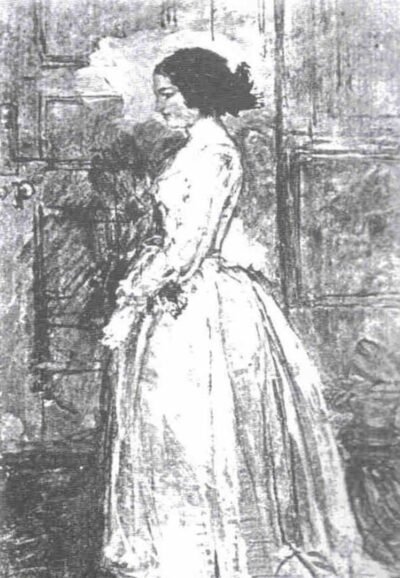
James Holland Morrant was born in 1835 and baptised just 10 days after the death of James’ son, Thomas William.

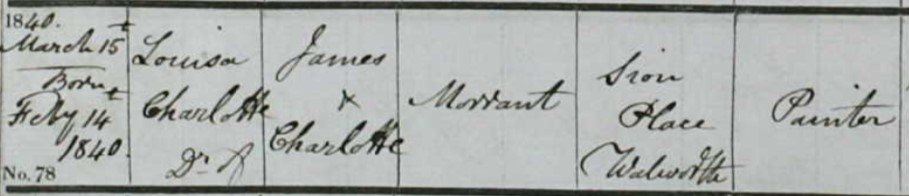
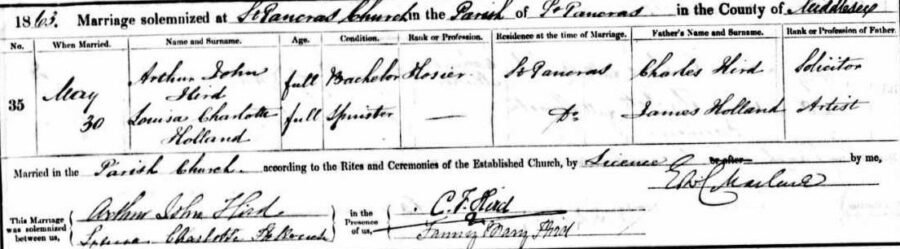
Charlotte Louisa Morrant, born on 14 February 1840, married Arthur John Hird as Louisa Charlotte Holland in May 1863. The couple had 8 children.
Alice Morrant Holland was born on 13 April 1851. In his will, James stipulated she was to be known as Alice Holland. She married Reverend Frank Mills Smith, a Baptist preacher, in 1893 but died of liver cancer on 16 July 1898.

Full Circle
The Edge family story is echoed to some extent in my own story. My parents lived in Stoke-on-Trent for a short time because my Dad worked at Chatterley Whitfield Colliery for the National Coal Board for a couple of years before moving back to the Black Country. I was born in Burslem during this time. My maternal grandmother never talked of Stoke-on-Trent in glowing terms and my mother often reminisced that she would despair as I would be covered in coal dust and grime when left in my pram. I have no memory that we ever visited my place of birth in my childhood and it was only in my late teens when I learnt to drive that I fully realised that Burslem was under 50 miles from my grandmother’s home.
My mother grew up around the corner from the former location of the Edge pottery in Brierley Hill and my grandmother later lived within a short walking distance. We all passed the location countless times and none of us realised that we actually had ancestors with strong ties to Burslem and the Potteries.